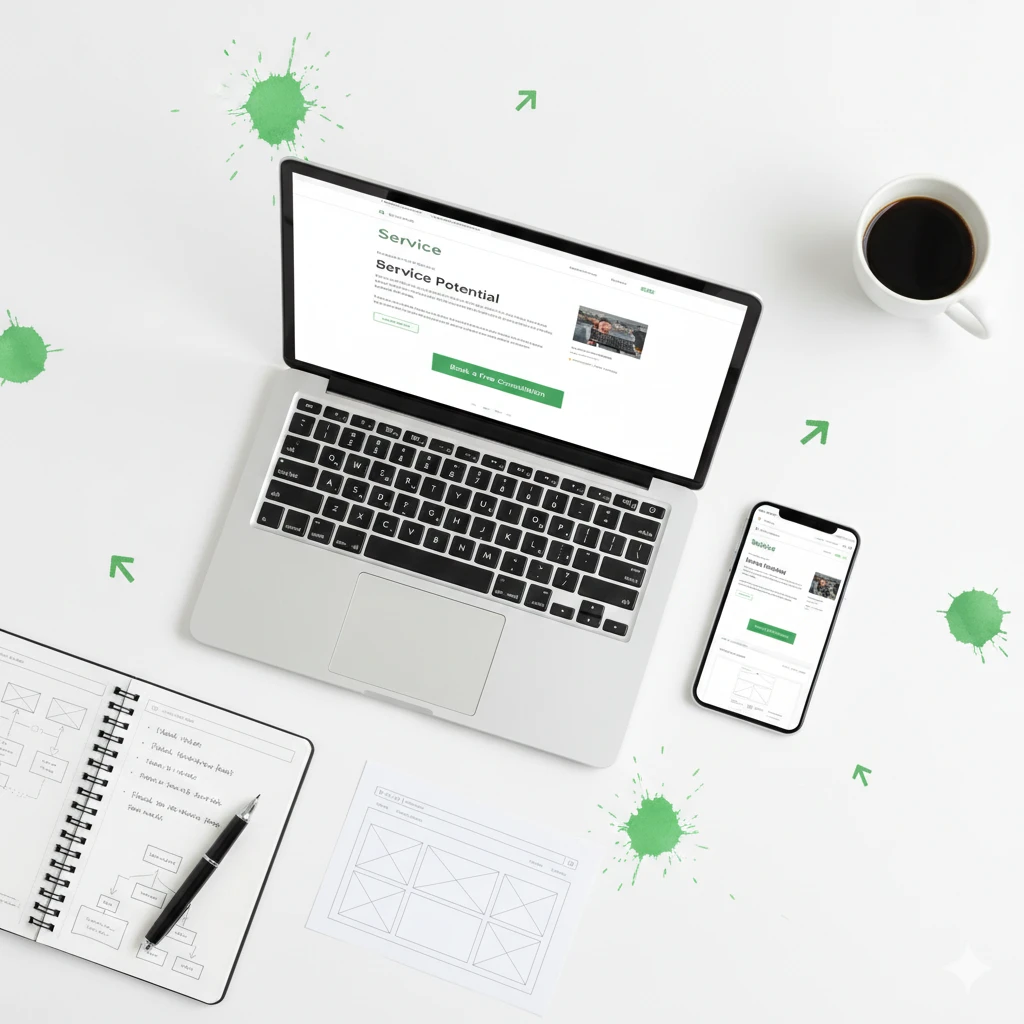
Creating service pages that sell transforms passive website visitors into paying customers for your small business. After all, your service pages represent the moment when curious browsers decide whether to contact you or click away to a competitor. Consequently, these pages deserve more strategic attention than most small business owners give them.
However, many businesses treat service pages as simple descriptions of what they offer. Specifically, they list features, throw in some generic benefits, and hope visitors figure out why they should choose this business. As a result, conversion rates suffer and potential customers slip away. According to Nielsen Norman Group research, users typically read only 20-28% of text on web pages.
This comprehensive guide covers proven techniques for writing service pages that actually convert visitors into customers.
Why Service Pages Matter More Than You Think
Service pages carry enormous weight in your website’s conversion funnel. Therefore, understanding their strategic importance motivates the investment required to optimize them.
Service pages capture high-intent visitors. Specifically, people viewing your service pages have moved beyond casual browsing. Additionally, they’re actively evaluating whether you can solve their specific problem. Furthermore, this intent makes service page visitors your most valuable traffic.
These pages directly influence revenue. Unlike blog posts that build awareness, service pages directly support purchasing decisions. Specifically, strong service pages increase conversion rates measurably. Consequently, improvements here deliver immediate bottom-line impact.
Service pages differentiate you from competitors. Most visitors compare multiple businesses before deciding. Specifically, your service pages must communicate why you’re the better choice. Furthermore, unique positioning and clear value propositions prevent you from competing solely on price.
Search engines value well-crafted service pages. Specifically, comprehensive service content ranks well for commercial keywords. Additionally, service pages that thoroughly address visitor questions earn featured snippets and strong rankings. Furthermore, good SEO brings more high-intent traffic to convert.
Understanding What Visitors Need
Before writing, understand what information visitors seek on service pages. Therefore, addressing their actual needs improves conversion rates significantly.
Questions Visitors Want Answered
Every service page visitor arrives with specific questions, whether conscious or not. Consequently, effective pages answer these questions proactively.
“What exactly do you offer?” Visitors need clear understanding of your services. Specifically, vague descriptions leave visitors confused about what they’d actually receive. Instead, describe your services with enough specificity that visitors can visualize the experience.
“Is this right for my situation?” Visitors need to self-qualify before reaching out. Specifically, help them understand who your services are designed for. Furthermore, clear qualification criteria prevent wasted time for everyone.
“What results can I expect?” Visitors want to know what success looks like. Specifically, outcomes matter more than processes for most buyers. Additionally, concrete results help visitors justify the investment to themselves or others.
“How much does it cost?” Pricing questions dominate visitor concerns. Specifically, hiding pricing frustrates visitors and increases bounce rates. Instead, provide pricing information or clear explanation of what determines cost.
“Why should I choose you?” Visitors need reasons to pick you over alternatives. Specifically, differentiation must be clear and compelling. Furthermore, generic claims like “quality service” don’t differentiate anyone.
“What happens next?” Visitors need a clear path forward. Specifically, uncertainty about next steps prevents action. Instead, make the process obvious and low-risk.
Visitor Psychology on Service Pages
Understanding how visitors think helps you write more persuasively. Consequently, psychological awareness improves conversion effectiveness.
Visitors are skeptical of marketing claims. Specifically, years of exposure to advertising have trained consumers to distrust promotional language. Therefore, prove claims with evidence rather than simply making them.
Decision fatigue affects visitors browsing multiple options. Specifically, too many choices and too much information overwhelm decision-making. Instead, simplify choices and highlight key differentiators clearly.
Loss aversion motivates action more than potential gains. Specifically, people fear missing out or making wrong decisions. Furthermore, addressing risks and offering guarantees reduces hesitation.
Social proof provides reassurance when making unfamiliar decisions. Specifically, testimonials, reviews, and case studies reduce perceived risk. Additionally, seeing others’ positive experiences builds confidence.
Structuring Service Pages for Maximum Impact
How you organize service page content affects how visitors perceive and process information. Therefore, strategic structure improves comprehension and conversion.
The Hero Section
Your hero section must capture attention and communicate value within seconds. Consequently, this prime real estate deserves careful optimization.
Write headlines that communicate clear value. Specifically, headlines should answer “what’s in it for me?” immediately. For instance, “Professional Website Design That Grows Your Business” beats “Our Web Design Services.” Additionally, benefit-focused headlines outperform feature-focused ones.
Include supporting subheadlines that add important context. Specifically, subheadlines can address secondary concerns or add specificity. Furthermore, they provide scanning visitors with quick understanding.
Feature relevant hero images that support your message. Specifically, images should show your service in action or results achieved. Additionally, avoid generic stock photos that could appear on any competitor’s site.
Add a clear call-to-action in the hero section. Specifically, visitors who are ready to act shouldn’t have to scroll. Furthermore, prominent CTAs capture high-intent visitors immediately.
The Problem/Solution Framework
Connecting your service to visitor problems creates relevance and urgency. Consequently, problem-focused framing improves engagement.
Acknowledge the problem your visitors face directly. Specifically, demonstrate that you understand their challenges. Additionally, describing their situation accurately builds credibility and connection.
Agitate the problem by highlighting consequences of inaction. Specifically, help visitors feel the weight of leaving problems unsolved. However, avoid manipulative fear tactics that damage trust.
Present your service as the solution to their specific problem. Specifically, position your offering as the bridge from pain to resolution. Furthermore, this framework creates natural flow toward your call-to-action.
Professional web design agencies like Monir Tech Solutions structure service pages that sell around this problem-solution framework. Specifically, connecting services to real customer problems creates relevance that generic feature lists cannot achieve. Furthermore, this approach demonstrates understanding of customer needs before any sales conversation.
Service Details and Features
After establishing relevance, provide the specific information visitors need. Consequently, comprehensive details support informed decision-making.
Describe what’s included with appropriate specificity. Specifically, list deliverables, features, and what customers can expect. Additionally, clarity prevents misunderstandings that lead to dissatisfied customers.
Explain your process for delivering the service. Specifically, walk visitors through what working with you looks like. Furthermore, process transparency reduces uncertainty and builds confidence.
Highlight what makes you different from alternatives. Specifically, unique aspects of your approach deserve emphasis. Additionally, differentiation gives visitors reasons to choose you specifically.
Address common questions within the page content. Specifically, proactive answers demonstrate thoroughness and expertise. Furthermore, answering questions reduces friction in the decision process.
Social Proof Elements
Testimonials and proof points build credibility essential for conversion. Consequently, strategic placement of social proof improves results.
Include relevant testimonials from customers with similar needs. Specifically, testimonials work best when visitors can relate to the customers quoted. Additionally, specific results mentioned in testimonials add credibility.
Display trust badges and certifications where appropriate. Specifically, industry certifications, security badges, and awards build confidence. However, only display relevant credentials that matter to your audience.
Mention notable clients or projects when impressive and permitted. Specifically, recognizable names provide instant credibility. Furthermore, even local recognition can build trust with regional audiences.
Include numbers and statistics that demonstrate capability. For instance, “500+ projects completed” or “15 years in business” provide concrete credibility. Additionally, specific numbers feel more believable than round figures.
Pricing Information
Pricing visibility affects conversion rates significantly. Consequently, thoughtful pricing presentation supports sales.
Display pricing when possible to qualify visitors and build trust. Specifically, hidden pricing frustrates visitors and suggests you’re expensive. Additionally, transparent pricing respects visitor time.
Explain pricing factors when exact quotes aren’t possible. Specifically, help visitors understand what influences cost. Furthermore, ranges with explanations satisfy curiosity better than complete opacity.
Justify your pricing by connecting cost to value delivered. Specifically, help visitors understand what they’re paying for. Additionally, value framing reduces price sensitivity.
Offer multiple options when appropriate to serve different budgets. Specifically, tiered pricing captures customers at various price points. Furthermore, options give visitors control over their investment level.
Clear Calls-to-Action
Strong CTAs guide visitors toward conversion. Consequently, CTA optimization directly impacts results.
Use action-oriented button text that describes what happens next. Specifically, “Get Your Free Quote” outperforms “Submit.” Additionally, specific language reduces uncertainty about what clicking initiates.
Place CTAs strategically throughout longer pages. Specifically, visitors ready to act shouldn’t have to scroll extensively. Furthermore, multiple CTAs capture visitors at different decision points.
Reduce perceived risk in CTA language when possible. For instance, “Schedule Free Consultation” feels lower risk than “Contact Sales.” Additionally, emphasizing “no obligation” can increase click-through rates.
Writing Persuasive Service Page Copy
The words you choose significantly impact conversion effectiveness. Therefore, developing copywriting skills improves your service page results.
Writing Headlines That Hook
Headlines determine whether visitors continue reading. Consequently, headline craft deserves focused attention.
Lead with benefits rather than features or service names. Specifically, benefits answer “why should I care?” immediately. For instance, “Get More Customers with Professional Web Design” beats “Web Design Services.”
Include your target audience when specificity helps. For instance, “Restaurant Website Design That Fills Tables” speaks directly to restaurant owners. Additionally, audience inclusion helps visitors self-identify as your ideal customers.
Create curiosity or urgency without resorting to clickbait. Specifically, compelling headlines promise value worth discovering. However, always deliver on headline promises in the content.
Test different headline approaches to discover what resonates. Specifically, A/B testing reveals which messages connect with your audience. Furthermore, headline improvements often deliver the largest conversion gains.
Focusing on Benefits Over Features
Features describe what you offer; benefits explain why it matters. Consequently, benefit-focused copy resonates more deeply with visitors.
Translate every feature into customer benefit. Specifically, ask “so what?” after stating each feature. For instance, “24/7 support” becomes “Get help whenever you need it, even at 2 AM.”
Use the “which means” technique to find benefits. Specifically, state a feature, add “which means,” and complete the sentence with customer impact. Furthermore, this technique reveals deeper benefits you might miss otherwise.
Focus on outcomes visitors actually want. Specifically, understand what success looks like from your customer’s perspective. Additionally, outcomes often involve status, security, time savings, or financial gains.
If writing persuasive service copy feels challenging, consider working with professionals who specialize in creating service pages that sell for small businesses. Schedule a free consultation with Monir Tech Solutions to discuss how we can help your service pages convert more visitors into customers.
Using Power Words Strategically
Certain words trigger stronger emotional responses. Consequently, strategic word choice enhances persuasive impact.
Words suggesting exclusivity create desire. For instance, “exclusive,” “limited,” “insider,” and “members-only” suggest special access. However, use exclusivity language only when genuinely applicable.
Words implying ease reduce perceived effort. For instance, “simple,” “effortless,” “quick,” and “easy” address concerns about difficulty. Additionally, these words work well when your service genuinely simplifies something complex.
Words conveying certainty build confidence. For instance, “guaranteed,” “proven,” “reliable,” and “trusted” address risk concerns. However, only use certainty words you can substantiate.
Words creating urgency motivate action. For instance, “now,” “today,” “limited,” and “last chance” encourage immediate response. However, artificial urgency damages trust when visitors recognize manipulation.
Writing for Scannability
Most visitors scan rather than read thoroughly. Consequently, scannable formatting improves content consumption.
Use descriptive subheadings that communicate value independently. Specifically, visitors scanning should grasp your message from headings alone. Additionally, subheadings break content into digestible sections.
Keep paragraphs short with 2-3 sentences maximum. Specifically, long paragraphs discourage reading on screens. Furthermore, white space between paragraphs improves perceived readability.
Employ bullet points for lists and multiple features. Specifically, bullets make information easier to scan and compare. Additionally, bullets draw attention to key points.
Bold important phrases that convey key benefits or differentiators. Specifically, bold text catches scanning eyes. However, overusing bold reduces its effectiveness.
Optimizing for Search Engines
Service pages should attract organic search traffic. Therefore, SEO optimization expands your reach to potential customers.
Keyword Strategy for Service Pages
Strategic keyword targeting brings qualified traffic. Consequently, keyword research deserves attention before writing.
Target commercial intent keywords that indicate buying readiness. Specifically, keywords including “services,” “company,” “near me,” or “cost” suggest purchase intent. Additionally, these keywords attract visitors more likely to convert.
Include location modifiers for local service businesses. Specifically, “Boston web design” or “web design services Massachusetts” capture local searchers. Furthermore, location keywords face less competition than national terms.
Address related questions through long-tail keyword targeting. Specifically, answer questions people ask when researching services. Additionally, comprehensive coverage improves rankings for multiple related queries.
On-Page SEO Elements
Technical optimization helps search engines understand and rank your pages. Consequently, proper on-page SEO supports visibility.
Craft optimized title tags including your primary keyword. Specifically, place keywords near the beginning while maintaining readability. Additionally, compelling titles improve click-through rates from search results.
Write meta descriptions that encourage clicks. Specifically, meta descriptions should summarize value and include calls-to-action. Furthermore, while not directly affecting rankings, good descriptions improve traffic.
Use header tags with appropriate keyword inclusion. Specifically, H1 tags should include your primary keyword naturally. Additionally, H2 and H3 tags organize content while targeting secondary terms.
Optimize images with descriptive file names and alt text. Specifically, image optimization contributes to overall page relevance. Additionally, optimized images can rank in image search results.
Common Service Page Mistakes to Avoid
Many businesses undermine their service pages through preventable errors. Therefore, avoiding these mistakes improves your results.
Focusing on yourself instead of the customer. Specifically, pages filled with “we” statements miss the point. Instead, frame everything around customer needs, problems, and outcomes.
Using generic, meaningless language. Specifically, phrases like “quality service” and “customer satisfaction” say nothing. Instead, make specific, verifiable claims that differentiate you.
Hiding or omitting pricing information. Specifically, price secrecy frustrates and discourages visitors. Instead, provide pricing or clear explanation of cost factors.
Writing walls of text without formatting. Specifically, dense paragraphs discourage reading entirely. Instead, use subheadings, bullets, and white space generously.
Lacking clear calls-to-action. Specifically, pages without obvious next steps lose potential customers. Instead, make desired actions clear and easy.
Ignoring mobile visitors. Specifically, poor mobile experience loses over half your potential customers. Instead, ensure pages work perfectly on all devices.
Making unsubstantiated claims. Specifically, claims without evidence feel like empty marketing. Instead, support claims with testimonials, data, or demonstrations.
Neglecting to update content. Specifically, outdated information damages credibility. Instead, review and refresh service pages regularly.
Service Page Checklist
Before publishing service pages, verify these essential elements:
Headline and Hero:
- Benefit-focused headline communicating clear value
- Supporting subheadline with important context
- Relevant, high-quality hero image
- Prominent call-to-action visible without scrolling
Content:
- Clear description of what’s included
- Benefits emphasized over features
- Problem-solution framework connecting to visitor needs
- Process explanation showing what to expect
- Differentiation from competitors clearly stated
Social Proof:
- Relevant testimonials from similar customers
- Trust badges or certifications displayed
- Numbers and statistics demonstrating capability
Pricing:
- Pricing displayed or factors explained
- Value justified relative to investment
- Options available for different budgets (if applicable)
Calls-to-Action:
- Action-oriented button text
- CTAs placed throughout the page
- Low-risk language reducing hesitation
SEO:
- Optimized title tag with primary keyword
- Compelling meta description
- Proper header tag hierarchy
- Images optimized with alt text
Technical:
- Mobile-responsive design verified
- Fast loading speed confirmed
- All links functional
Industry-Specific Considerations
Different industries require different approaches to service pages. Therefore, consider these industry-specific recommendations.
Restaurant Services
Restaurant service pages (catering, private events, delivery) should emphasize experience and taste. Specifically, high-quality food photography creates appetite appeal. Additionally, menu options and customization possibilities deserve prominent placement.
Include capacity information, dietary accommodation options, and booking processes clearly. Furthermore, testimonials from successful events build confidence for larger bookings.
Retail Services
Retail services like personal shopping, alterations, or gift wrapping should emphasize convenience and expertise. Specifically, explain how services save time or enhance purchases. Additionally, showcase expertise through staff credentials or experience.
Include pricing, turnaround times, and any limitations clearly. Furthermore, photos showing service quality help visitors understand what to expect.
Professional Services
Professional services require credibility-building throughout. Specifically, credentials, experience, and methodology deserve prominent placement. Additionally, case studies demonstrating results provide powerful proof.
Address common concerns about working with professionals, including costs, timelines, and communication expectations. Furthermore, process transparency reduces anxiety about unfamiliar service experiences.
Real Estate Services
Real estate service pages should emphasize local expertise and track record. Specifically, market knowledge and transaction history build credibility. Additionally, explain the buying or selling process clearly for first-time clients.
Include testimonials from satisfied buyers and sellers prominently. Furthermore, neighborhood expertise and market insights differentiate you from competitors.
Measuring Service Page Performance
Tracking performance reveals improvement opportunities. Therefore, establish measurement practices for ongoing optimization.
Key Metrics to Monitor
Different metrics indicate different aspects of service page effectiveness. Consequently, track metrics aligned with your goals.
Conversion rate measures the percentage of visitors taking desired action. Specifically, this metric directly indicates page effectiveness. Additionally, segment by traffic source to identify quality differences.
Bounce rate shows the percentage leaving without interaction. Specifically, high bounce rates suggest content or targeting problems. Furthermore, compare against site averages to identify underperformers.
Time on page indicates engagement with your content. Specifically, longer times suggest visitors reading thoroughly. However, very long times might indicate confusion or difficulty finding information.
Scroll depth reveals how far visitors read. Specifically, significant drop-off points indicate content problems. Additionally, this data guides content reorganization for better engagement.
Continuous Improvement Process
Regular optimization improves results over time. Consequently, establish ongoing improvement practices.
Review metrics monthly to identify trends and problems. Specifically, regular monitoring catches issues before they significantly impact results. Additionally, tracking changes over time reveals improvement trajectory.
Test changes systematically rather than making random adjustments. Specifically, A/B testing provides data to guide decisions. Furthermore, testing prevents making changes that actually hurt performance.
Gather qualitative feedback through customer conversations. Specifically, ask new customers what convinced them to reach out. Additionally, this feedback reveals persuasive elements to emphasize.
Next Steps for Your Business
Ready to create service pages that sell for your small business? Start with these priority actions:
First, audit your existing service pages against the checklist provided. Second, rewrite headlines to focus on customer benefits rather than service names. Third, add relevant testimonials and social proof throughout. Finally, ensure clear calls-to-action appear prominently on every service page.
Service page optimization delivers measurable results relatively quickly. Therefore, prioritize these improvements for immediate impact on your conversion rates.
Get Professional Help with Your Website
Creating high-converting service pages requires copywriting skill, design expertise, and conversion optimization knowledge. At Monir Tech Solutions, we specialize in building affordable websites with service pages that sell for small businesses including restaurants, retail stores, and real estate professionals.
Our team delivers:
- Professional website design with conversion-focused service pages
- Persuasive copywriting that communicates your unique value
- Mobile-responsive layouts that work perfectly on all devices
- SEO optimization to bring qualified traffic to your service pages
- 24/7 support so you’re never left without help
- Budget-friendly pricing with no hidden monthly fees
Ready to build service pages that actually convert visitors into customers?
👉 Get a Free Quote — Tell us about your project and receive a customized quote with no obligation.
👉 Schedule a Free Consultation — Book a no-obligation call to discuss your website and service page needs with our team.
Your services deserve pages that communicate their true value. Let’s build something that turns your website visitors into paying customers.